
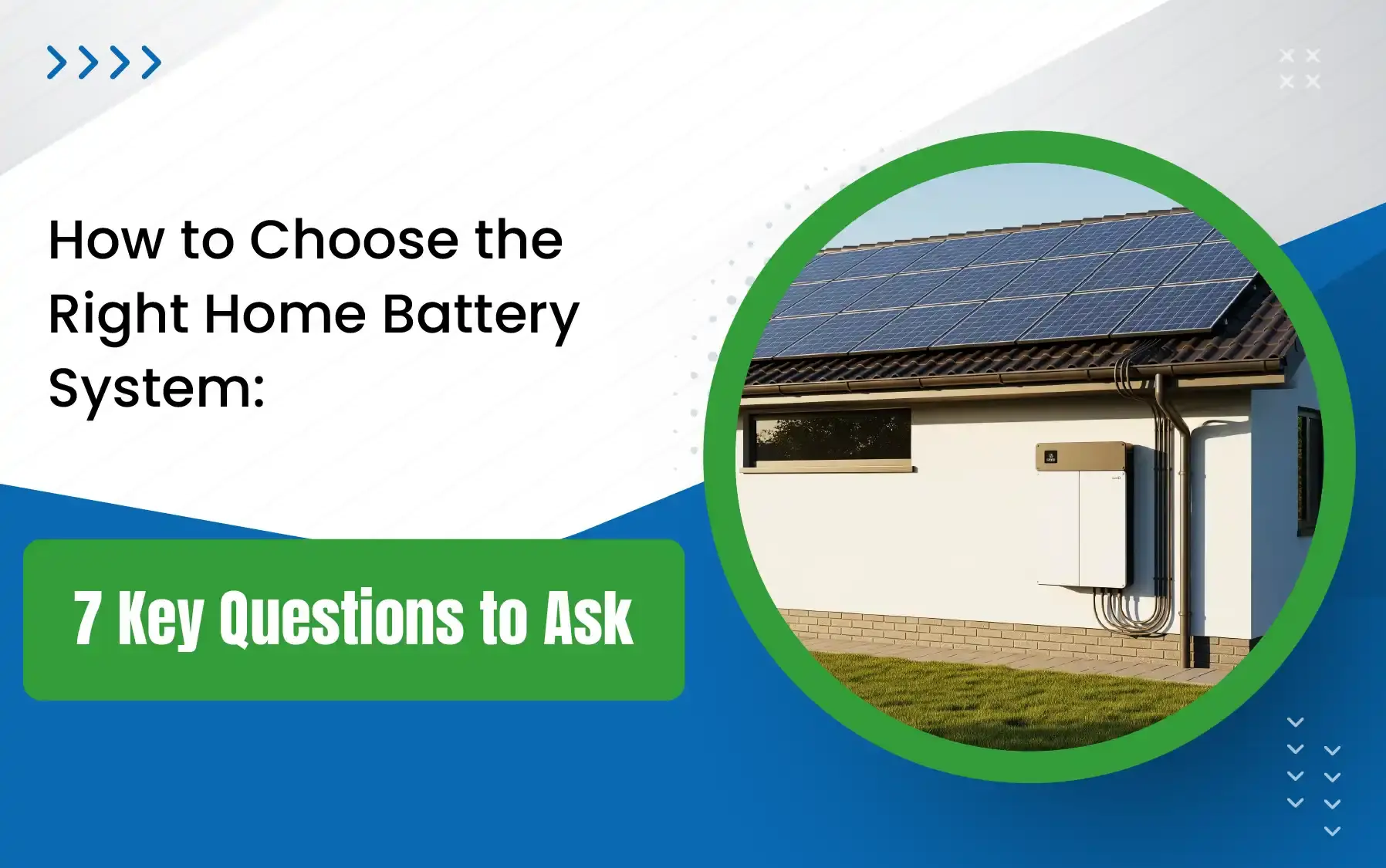
Finding the Perfect Battery for Your Home Doesn’t Have to Be Hard
With more battery systems on the market than ever, selecting the right one for your home can feel overwhelming. But by asking the right questions upfront, you can make an informed choice, one that fits your energy needs, budget, and long-term plans. Here’s a clear guide to help you navigate the decision.
1. What Is the Battery’s Real Storage Capacity (kWh)
The headline capacity (e.g., “10 kWh battery”) doesn’t always tell the full story. What matters more is the usable capacity, how much energy you can actually draw before recharging.
- Check usable storage after accounting for inefficiencies and depth-of-discharge limits.
- Ensure the battery size aligns with your overnight or peak-usage demand.
- Consider future energy needs (EV charging, heating/cooling, appliance upgrades).
2. What Battery Chemistry Is Used, and Does It Affect Lifespan?
Lithium-ion batteries dominate the home storage market. Within that, there are variants like LFP (Lithium Iron Phosphate) or NMC (Nickel Manganese Cobalt). Your choice affects longevity, safety, and performance.
- LFP batteries tend to be more stable, longer-lasting, and safer.
- Consider cycle life (how many full charge/discharge cycles before capacity drops).
- Check the manufacturer’s warranty and projected capacity retention over time.
3. Is the System Compatible with Your Inverter and Solar Setup?
A battery isn’t useful on its own; it needs to be integrated with your solar system (or grid supply) and an inverter. Compatibility determines how smoothly your system runs.
- Confirm that the battery works with your existing inverter, or plan to upgrade.
- Ensure peak power output supports your household’s load (appliances, HVAC, EV charger).
- Verify installation meets Australian electrical and safety standards.
4. Does the Battery Offer Backup/Blackout Support?
One of the major benefits of battery storage is resilience—being able to run parts or all of your home during blackouts. But not all systems offer full home backup.
- Ask whether the battery supports whole-home or essential-loads backup.
- Check switchover time (how quickly your system reconnects to battery power during an outage).
- Understand which circuits/appliances can run during a blackout.
5. What Are the Warranty Terms and Long-Term Reliability?
Batteries are a long-term investment. A strong warranty and reliable performance over time significantly impact the overall value and peace of mind.
- Review warranty length and what it covers (capacity degradation, manufacturing defects, etc.).
- Understand expected capacity retention after the warranty period (e.g., 80–90% over 10+ years).
- Research manufacturer reputation, reviews, and real-world performance.
6. What’s the True Cost, and What’s the Payback Period?
Beyond sticker price, the total cost includes installation, inverter upgrades (if needed), maintenance, and opportunity cost, but so do the benefits: energy savings, feed-in tariffs avoided, and future energy independence.
- Request a full upfront cost breakdown (battery, inverter, installation, compliance).
- Calculate how much you save annually on electricity bills, grid fees, and feed-in tariffs.
- Estimate the payback period based on your typical energy usage and savings rate.
7. Does It Fit Your Long-Term Energy Goals?
Your energy needs may change by adding an EV, upgrading to an all-electric home, or expanding household load. Choose a system that’s scalable and ready for future upgrades.
- Opt for modular systems that allow adding additional storage capacity later.
- Ensure the system design accommodates potential upgrades like an EV charger, a heat pump, and more solar.
- Think beyond immediate savings; look for long-term sustainability, independence, and flexibility.
Final Thoughts: Choose Wisely, Plan Ahead, and Power On
Selecting a home battery system isn’t just about capacity or cost; it’s about aligning your energy solution with your lifestyle, long-term goals, and comfort. By asking the right questions and factoring in future needs, you can make a smart investment that pays off for years.
At EcoGreen Homes, we help you navigate every step, from understanding your energy usage and assessing battery options to ensuring compatibility to installation and rebate support.
Ready to find the right battery for your home? Reach out for a free consultation; we’ll help you design a customized and future-ready energy solution.
Frequently Asked Questions
Usable capacity is the actual energy you can draw from the battery. For example, a 10 kWh battery may only provide 8–9 kWh of usable power due to protection limits that help extend battery lifespan. Always compare usable capacity, not just nominal capacity.
Both LFP (Lithium Iron Phosphate) and NMC (Nickel Manganese Cobalt) are safe and effective. However, LFP is generally preferred for home batteries because it offers:
- Longer cycle life
- Higher thermal stability
- Better safety profile
- Less degradation over time
NMC provides higher energy density and is more commonly used in electric vehicles rather than home storage.
Your installer can confirm inverter compatibility. Some systems require a hybrid inverter, while others work with an AC-coupled battery. If your current inverter is older than 8–10 years, an upgrade may be recommended for optimal performance.
This depends on your budget and priorities:
- Essential-loads backup: Powers refrigerators, lights, internet and small appliances during blackouts.
- Whole-home backup: Runs everything including heating and cooling systems, but requires a larger battery and more complex installation.
Key factors include:
- Your daily solar generation
- How much power you use during peak hours
- Feed-in tariff vs. electricity tariff difference
- Battery size
- Whether you charge an EV at home
With correct sizing, most homes achieve payback between 5 and 10 years.
Yes, many battery systems are modular, allowing you to add more storage later as your energy needs grow. This is ideal if you plan to add EVs, heat pumps or additional solar panels in the future.
Almost none. Modern lithium-ion batteries require minimal maintenance. Just ensure:
- Proper ventilation
- Clean surroundings
- Occasional monitoring through the mobile app
Most issues, if any, are detected automatically by the system.
Yes, as long as Australian Standards (AS/NZS 5139) are followed. Installations must meet clearance, ventilation and fire-safety guidelines. Accredited installers ensure full compliance for safe indoor or garage installations.